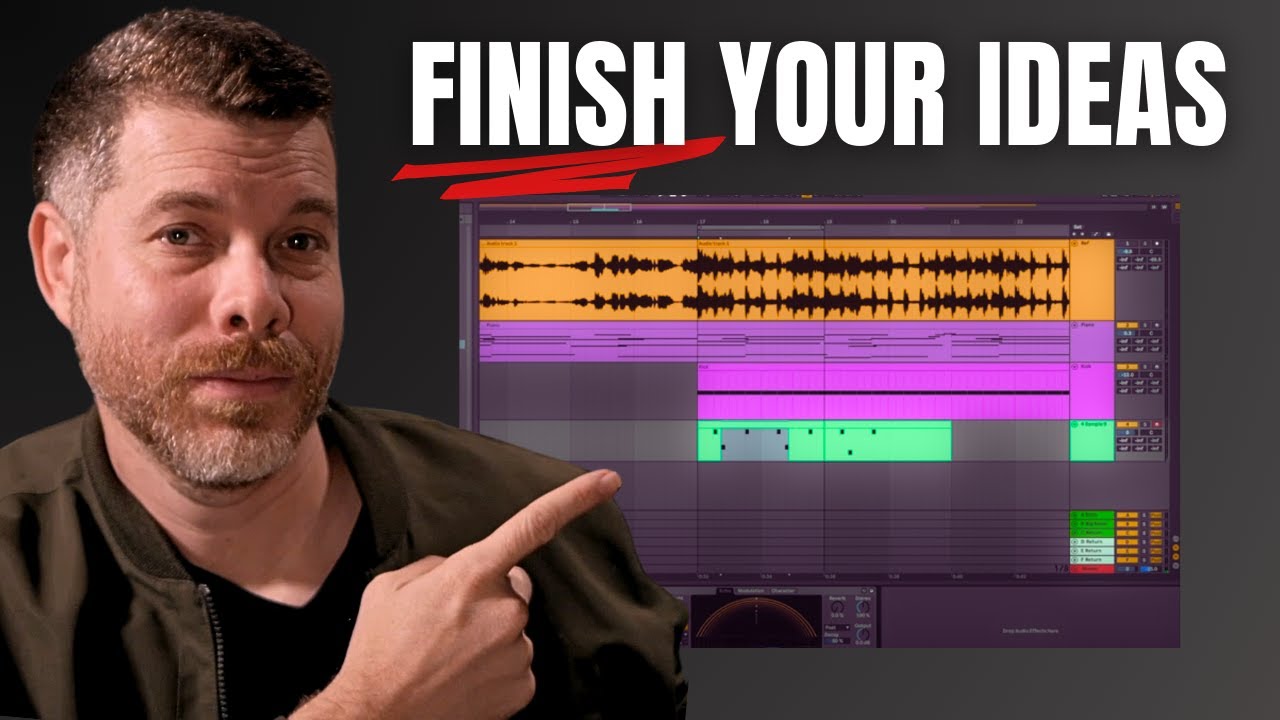
How to Finally Finish Your Songs: Simple Workflow to Beat the 8-Bar Loop Trap
How to Finally Finish Your Songs: A Simple Step-By-Step Workflow
If your hard drive is full of eight-bar loops, half-finished beats, and voice memos that never become real songs, you’re not broken—you’re normal.
But if you want to grow as a producer, you can’t stay stuck in “idea mode” forever.
After 24 years of producing music professionally and helping thousands of producers, I’ve learned this:
Finishing songs isn’t about talent. It’s about having a repeatable workflow that protects your creative momentum.
In this post, I’ll walk you through a simple process you can use in any DAW to take an idea from spark → structured demo that’s ready to be finished and released.
Why You’re Stuck With Unfinished Ideas
Most producers get stuck because they:
Obsess over sound design and mixing too early
Keep looping the same 4–8 bars
Open a blank project and freeze
Lose the initial spark while tweaking details
The fix is not more plugins—it’s a different order of operations.
Your new rule:
Protect creative momentum first. Polish later.
Step 1 – Capture the First Idea Fast
Your idea can come from anywhere:
A guitar riff or chord progression
A loop or preset that inspires you
A melody you hummed into your phone
The important part is not what it is, but how quickly you capture it.
Drop your instrument of choice in your DAW.
Jam until something feels good.
Hit record—or use features like Ableton’s MIDI Capture if you forgot.
As soon as you have a loop that makes you nod your head or sing a melody over it, stop tweaking. You’ve got your seed.
Step 2 – Add Drums Without Killing the Vibe
Next, build a basic drum groove to give your idea a heartbeat.
A few guidelines:
Keep the pattern simple (kick + snare + basic hat pattern).
Play it in by hand if you can, then lightly quantize so it still feels human.
Don’t spend 30 minutes auditioning snares.
Pick a workable kick and snare.
You can swap samples later in 10 seconds.
Your only goal here is to create movement, not a “final mix.”
💡 If you catch yourself zoomed in on a snare EQ at this stage, you’re already off track.
Step 3 – Build a “Song Skeleton” Early
This is where most producers blow it—they keep looping instead of arranging.
Once you have:
A core musical idea (riff, chords, or loop)
A basic drum groove
Maybe a bass or percussive loop
…move into arrangement mode.
Treat what you have as your chorus/drop (or the main section), then:
Copy it out in your DAW timeline.
Strip elements away to create:
Intro
Verse
Pre-chorus
Chorus
You don’t need tons of extra parts yet. You’re just shaping sections:
Intro → maybe just guitar/pad
Verse → drums + main riff, no hats or 808 yet
Pre-chorus → introduce bass, loop, or extra percussion
Chorus → bring everything in
This “song skeleton” kills the endless loop problem and gives your brain a clear finish line.
Step 4 – Use a Reference Track to Guide Structure
Instead of guessing your way through arrangement, borrow from songs that already work.
Drop a reference track into your session (something in a similar tempo and vibe) and:
Mark where their verse, pre, and chorus start
Count how many bars each section lasts
Notice what gets added or removed at each transition
You’re not copying the song—you’re copying the logic.
Use their structure as a map while you build your own sections. This keeps you from over-writing (or under-building) your song.
Step 5 – Record a Rough Vocal (Even if It’s Mumbled)
This is the step most producers skip—and it’s why their projects stall.
Once you have a basic arrangement:
Create a “Rough Vox” track.
Record a scratch vocal idea:
It can be nonsense words.
It can be off-key.
It can sound like a “dying giraffe.” That’s fine.
The point is to capture melody and rhythm, not perfection.
That rough vocal now becomes your guardrail:
It tells you what sections need more lift or contrast.
It stops you from overfilling the track with unnecessary layers.
It turns your beat into a song.
At this stage, you’ve done the hardest part: you’ve gone from idea to a fully mapped demo.
From here, finishing is about:
Refining sounds
Cleaning transitions
Re-recording proper vocals
Mixing and polishing
Finish vs. Perfect: When to Move On
Here’s a mindset shift that will help you finish way more music:
A finished, imperfect song will grow you more than a “perfect” loop that never leaves your hard drive.
Once your track has:
A clear structure
A defined melody
A coherent groove
A beginning, middle, and end
…you can call it a finished demo and move on to the next one, or into mixing.
The goal is to build the habit of finishing, not creating your “magnum opus” every time.
Want a Step-By-Step System to Finish Your First Song?
If you’re just getting started and want a clear, distraction-free path to finishing a full track:
👉 Grab my free course that walks you through producing your very first song
https://beatacademy.com/produce
And if you’re beyond the basics and want direct guidance to consistently finish release-ready tracks:
👉 Apply for Beat Academy Mentorship
Work with me and get a personalized roadmap to finally finishing music you’re proud to share.
https://beatacademy.com/mentorship
